
Termlife
Terminal-Based Conway's Game of Life
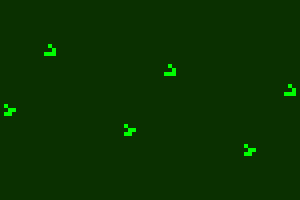
A fun terminal-based implementation of Conway's Game of Life written in Go. Distributed as a single binary requiring no configuration - just download and run to watch cellular automaton patterns evolve in real-time directly in your terminal.
Demo
Key Features
Everything you need to explore cellular automata from your terminal.
Zero Configuration
Single binary distribution - just download and run. No setup, no dependencies, no configuration files needed.
Multiple Preset Patterns
Built-in patterns including glider, Gosper gun, pulsar, and more. Start exploring cellular automata immediately.
Color Themes
Six beautiful color themes including matrix green, amber CRT, and cyan variants to match your terminal aesthetic.
Adjustable Speed
Control frame rates from 1-60 fps. Slow down to study patterns or speed up to watch evolution unfold.
Custom Rulesets
Support for alternative cellular automaton rules using Birth/Survival notation. Try HighLife, Maze, or Replicator.
GIF Export
Generate animated GIF recordings of your simulations with configurable scaling and timing options.
Installation
Multiple installation options for your platform of choice.
brew install TickTockBent/tap/termlifeDownload .deb from releasesDownload .rpm from releasesDownload .exe from releasesgo install github.com/TickTockBent/termlife@latestInteractive Controls
Full keyboard control for real-time interaction with your simulation. Pause, step through generations, draw patterns, and adjust settings on the fly.
# Run with default settings
termlife

# Start with a specific pattern
termlife --pattern glider
termlife --pattern gosper

# Customize appearance
termlife --theme matrix --fps 30

# Enable toroidal wrapping
termlife --wrap

# Use custom rules (HighLife)
termlife --rules B36/S23

# Export a GIF animation
termlife --export animation.gif --frames 100
What is Conway's Game of Life?
The Game of Life is a cellular automaton devised by mathematician John Conway in 1970. It's a zero-player game where evolution is determined by the initial state - no further input is needed. Cells live, die, or reproduce based on simple rules, yet complex and beautiful patterns emerge from these interactions.
Birth
A dead cell with exactly 3 live neighbors becomes alive.
Survival
A live cell with 2 or 3 live neighbors survives to the next generation.
Death
All other live cells die from loneliness or overcrowding.
Ready to Play?
Download termlife and start exploring the fascinating world of cellular automata right from your terminal.